
مشخصات کتاب
-
Simon Robinson
-
2004
-
انگلیسی
-
4191
-
530
-
1
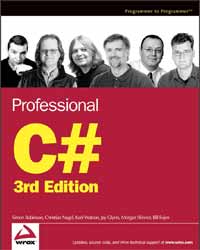
Professional C# Third Edition
Contents
Introduction xxvii
Part I: The C# Language 1
Chapter 1: .NET Architecture 3
The Relationship of C# to .NET 4
The Common Language Runtime 4
Advantages of Managed Code 4
A Closer Look at Intermediate Language 7
Support for Object Orientation and Interfaces 8
Distinct Value and Reference Types 9
Strong Data Typing 9
Error Handling with Exceptions 16
Use of Attributes 17
Assemblies 17
Private Assemblies 18
Shared Assemblies 19
Reflection 19
.NET Framework Classes 19
Namespaces 21
Creating .NET Applications Using C# 21
Creating ASP.NET Applications 21
Creating Windows Forms 24
Windows Services 24
The Role of C# in the .NET Enterprise Architecture 24
Summary 26
Chapter 2: C# Basics 29
Before We Start 30
Our First C# Program 30
The Code 30
Compiling and Running the Program 31
A Closer Look 31
Variables 34
Initialization of Variables 34
Variable Scope 35
Constants 38
Predefined Data Types 39
Value Types and Reference Types 39
CTS Types 40
Predefined Value Types 41
Predefined Reference Types 44
Flow Control 47
Conditional Statements 47
Loops 51
Jump Statements 54
Enumerations 55
Arrays 57
Namespaces 58
The using Statement 59
Namespace Aliases 60
The Main() Method 61
Multiple Main() Methods 61
Passing Arguments to Main() 62
More on Compiling C# Files 63
Console I/O 65
Using Comments 67
Internal Comments Within the Source Files 67
XML Documentation 68
The C# Preprocessor Directives 70
#define and #undef 70
#if, #elif, #else, and #endif 71
#warning and #error 72
#region and #endregion 72
#line 72
C# Programming Guidelines 73
Rules for Identifiers 73
Usage Conventions 74
Summary 81
Chapter 3: Objects and Types 83
Classes and Structs 84
Class Members 85
Data Members 85
Function Members 85
readonly Fields 99
Structs 101
Structs Are Value Types 102
Structs and Inheritance 103
Constructors for Structs 103
The Object Class 104
System.Object Methods 104
The ToString() Method 105
Summary 107
Chapter 4: Inheritance 109
Types of Inheritance 109
Implementation Versus Interface Inheritance 109
Multiple Inheritance 110
Structs and Classes 110
Implementation Inheritance 111
Virtual Methods 112
Hiding Methods 113
Calling Base Versions of Functions 114
Abstract Classes and Functions 115
Sealed Classes and Methods 115
Constructors of Derived Classes 116
Modifiers 122
Visibility Modifiers 122
Other Modifiers 123
Interfaces 123
Defining and Implementing Interfaces 125
Derived Interfaces 128
Summary 130
Chapter 5: Operators and Casts 131
Operators 131
Operator Shortcuts 133
The Ternary Operator 134
The checked and unchecked Operators 134
The is Operator 135
The as Operator 136
The sizeof Operator 136
The typeof Operator 136
Operator Precedence 137
Type Safety 137
Type Conversions 138
Boxing and Unboxing 141
Comparing Objects for Equality 142
Comparing Reference Types for Equality 142
The ReferenceEquals() Method 142
The virtual Equals() Method 143
The static Equals() Method 143
Comparison Operator (==) 143
Comparing Value Types for Equality 143
Operator Overloading 144
How Operators Work 145
Operator Overloading Example: The Vector Struct 146
Which Operators Can You Overload? 153
User-Defined Casts 154
Implementing User-Defined Casts 155
Multiple Casting 161
Summary 165
Chapter 6: Delegates and Events 167
Delegates 167
Using Delegates in C# 169
SimpleDelegate Example 172
BubbleSorter Example 174
Multicast Delegates 177
Events 179
The Receiver’s View of Events 180
Generating Events 182
Summary 186
Chapter 7: Memory Management and Pointers 187
Memory Management under the Hood 187
Value Data Types 188
Reference Data Types 190
Garbage Collection 192
Freeing Unmanaged Resources 193
Destructors 193
The IDisposable Interface 195
Implementing IDisposable and a Destructor 196
Unsafe Code 197
Pointers 198
Pointer Example: PointerPlayaround 207
Using Pointers to Optimize Performance 212
Summary 216
Chapter 8: Strings and Regular Expressions 217
System.String 218
Building Strings 219
Format Strings 223
Regular Expressions 229
Introduction to Regular Expressions 229
The RegularExpressionsPlayaround Example 230
Displaying Results 233
Matches, Groups, and Captures 234
Summary 237
Chapter 9: Collections 239
Examining Groups of Objects 239
Array Lists 240
Collections 241
Dictionaries 245
Summary 256
Chapter 10: Reflection 257
Custom Attributes 258
Writing Custom Attributes 258
Custom Attribute Example: WhatsNewAttributes 262
Reflection 265
The System.Type Class 266
The TypeView Example 268
The Assembly Class 271
Completing the WhatsNewAttributes Sample 272
Summary 276
Chapter 11: Errors and Exceptions 277
Looking into Errors and Exception Handling 277
Exception Classes 278
Catching Exceptions 280
User-Defined Exception Classes 290
Summary 297
Part II: The .NET Environment 299
Chapter 12: Visual Studio .NET 301
Working with Visual Studio .NET 2003 301
Creating a Project 304
Solutions and Projects 311
Windows Application Code 314
Reading in Visual Studio 6 Projects 314
Exploring and Coding a Project 315
Building a Project 326
Debugging 331
Other .NET Tools 334
The ASP.NET Web Matrix Project 335
WinCV 335
Summary 337
Chapter 13: Assemblies 339
What Are Assemblies? 339
The Answer to DLL Hell 340
Features of Assemblies 341
Application Domains and Assemblies 341
Assembly Structure 344
Assembly Manifests 346
Namespaces, Assemblies, and Components 346
Private and Shared Assemblies 347
Viewing Assemblies 347
Building Assemblies 348
Cross-Language Support 353
The CTS and the CLS 353
Language Independence in Action 354
CLS Requirements 364
Global Assembly Cache 366
Native Image Generator 366
Global Assembly Cache Viewer 367
Global Assembly Cache Utility (gacutil.exe) 368
Creating Shared Assemblies 369
Shared Assembly Names 369
Creating a Shared Assembly 371
Configuration 376
Configuration Categories 376
Versioning 377
Configuring Directories 387
Summary 390
Chapter 14: .NET Security 391
Code Access Security 392
Code Groups 393
Code Access Permissions and Permissions Sets 399
Policy Levels: Machine, User, and Enterprise 403
Support for Security in the Framework 405
Demanding Permissions 406
Requesting Permissions 407
Implicit Permission 410
Denying Permissions 411
Asserting Permissions 412
Creating Code Access Permissions 414
Declarative Security 414
Role-Based Security 415
The Principal 415
Windows Principal 416
Roles 417
Declarative Role-Based Security 418
Managing Security Policy 419
The Security Configuration File 419
Managing Code Groups and Permissions 423
Turning Security On and Off 423
Resetting Security Policy 423
Creating a Code Group 423
Deleting a Code Group 424
Changing a Code Group’s Permissions 424
Creating and Applying Permissions Sets 425
Distributing Code Using a Strong Name 427
Distributing Code Using Certificates 429
Managing Zones 435
Summary 437
Chapter 15: Threading 439
Threading 439
Applications with Multiple Threads 441
Manipulating Threads 441
The ThreadPlayaround Sample 444
Thread Priorities 448
Synchronization 449
Summary 453
Chapter 16: Distributed Applications with .NET Remoting 455
What Is .NET Remoting? 456
Application Types and Protocols 456
CLR Object Remoting 457
.NET Remoting Overview 457
Contexts 460
Activation 461
Attributes and Properties 461
Communication between Contexts 462
Remote Objects, Clients, and Servers 462
Remote Objects 462
A Simple Server 464
A Simple Client 465
.NET Remoting Architecture 466
Channels 466
Formatters 470
ChannelServices and RemotingConfiguration 471
Object Activation 472
Message Sinks 476
Passing Objects in Remote Methods 476
Lifetime Management 481
Miscellaneous .NET Remoting Features 484
Configuration Files 484
Hosting Applications 494
Classes, Interfaces, and SoapSuds 495
Asynchronous Remoting 498
Remoting and Events 499
Call Contexts 505
Summary 507
Chapter 17: Localization 509
Namespace System.Globalization 510
Unicode Issues 510
Cultures and Regions 511
Cultures in Action 516
Sorting 520
Resources 522
Creating Resource Files 522
ResGen 523
ResourceWriter 523
Using Resource Files 524
The System.Resources Namespace 527
Localization Example Using Visual Studio .NET 527
Outsourcing Translations 533
Changing the Culture Programmatically 534
Using Binary Resource Files 536
Using XML Resource Files 537
Automatic Fallback for Resources 539
Globalization and Localization with ASP.NET 539
A Custom Resource Reader 540
Creating a DatabaseResourceReader 541
Creating a DatabaseResourceSet 542
Creating a DatabaseResourceManager 543
Client Application for DatabaseResourceReader 544
Summary 544
Chapter 18: Deployment 545
Designing for Deployment 545
Deployment Options 546
Xcopy 546
Copy Project 546
Deployment Projects 546
Deployment Requirements 546
Simple Deployment 547
Xcopy 548
Xcopy and Web Applications 548
Copy Project 550
Installer Projects 551
What Is Windows Installer? 551
Creating Installers 552
Advanced Options 562
Summary 569
Part III: Windows Forms 571
Chapter 19: Windows Forms 573
Creating a Windows Form Application 574
Control Class 579
Size and Location 580
Appearance 580
User Interaction 580
Windows Functionality 582
Miscellaneous Functionality 582
Class Hierarchy 582
Standard Controls and Components 584
Forms 598
Form Class 599
Multiple Document Interface (MDI) 607
Custom Controls 610
Summary 622
Chapter 20: Graphics with GDI+ 623
Understanding Drawing Principles 624
GDI and GDI+ 624
Drawing Shapes 626
Painting Shapes Using OnPaint() 629
Using the Clipping Region 630
Measuring Coordinates and Areas 632
Point and PointF 632
Size and SizeF 634
Rectangle and RectangleF 635
Region 636
A Note about Debugging 637
Drawing Scrollable Windows 638
World, Page, and Device Coordinates 644
Colors 645
Red-Green-Blue (RGB) Values 645
The Named Colors 646
Graphics Display Modes and the Safety Palette 646
The Safety Palette 647
Pens and Brushes 648
Brushes 648
Pens 649
Drawing Shapes and Lines 650
Displaying Images 652
Issues When Manipulating Images 655
Drawing Text 655
Simple Text Example 656
Fonts and Font Families 657
Example: Enumerating Font Families 659
Editing a Text Document: The CapsEditor Sample 661
The Invalidate() Method 666
Calculating Item Sizes and Document Size 667
OnPaint() 668
Coordinate Transforms 670
Responding to User Input 671
Printing 675
Implementing Print and Print Preview 676
Summary 680
Part IV: Data 683
Chapter 21: Data Access with .NET 685
ADO.NET Overview 685
Namespaces 686
Shared Classes 686
Database-Specific Classes 687
Using Database Connections 688
Using Connections Efficiently 689
Transactions 692
Commands 693
Executing Commands 694
Calling Stored Procedures 698
Fast Data Access: The Data Reader 701
Managing Data and Relationships: The DataSet Class 704
Data Tables 704
Data Columns 705
Data Relationships 711
Data Constraints 713
XML Schemas 715
Generating Code with XSD 716
Populating a DataSet 721
Populating a DataSet Class with a Data Adapter 722
Populating a DataSet from XML 723
Persisting DataSet Changes 723
Updating with Data Adapters 724
Writing XML Output 726
Working with ADO.NET 728
Tiered Development 728
Key Generation with SQL Server 730
Naming Conventions 732
Summary 734
Chapter 22: Viewing .NET Data 735
The DataGrid Control 735
Displaying Tabular Data 735
Data Sources 738
DataGrid Class Hierarchy 746
Data Binding 750
Simple Binding 750
Data-Binding Objects 751
Visual Studio.NET and Data Access 757
Creating a Connection 758
Selecting Data 759
Generating a DataSet 762
Updating the Data Source 763
Building a Schema 764
Other Common Requirements 770
Summary 778
Chapter 23: Manipulating XML 781
XML Standards Support in .NET 782
Introducing the System.Xml Namespace 782
Using MSXML in .NET 783
Using System.Xml Classes 786
Reading and Writing Streamed XML 786
Using the XmlTextReader Class 787
Using the XmlValidatingReader Class 791
Using the XmlTextWriter Class 794
Using the DOM in .NET 795
Using the XmlDocument Class 797
Using XPath and XSLT in .NET 802
The System.Xml.XPath Namespace 803
The System.Xml.Xsl Namespace 807
XML and ADO.NET 812
Converting ADO.NET Data to XML 812
Converting XML to ADO.NET Data 820
Reading and Writing a DiffGram 822
Serializing Objects in XML 825
Serialization without Source Code Access 833
Summary 836
Chapter 24: Working with Active Directory 837
The Architecture of Active Directory 838
Features 838
Active Directory Concepts 839
Characteristics of Active Directory Data 843
Schema 843
Administration Tools for Active Directory 845
Active Directory Users and Computers 845
ADSI Edit 846
Active Directory Service Interfaces (ADSI) 847
Programming Active Directory 848
Classes in System.DirectoryServices 849
Binding 849
Getting Directory Entries 854
Object Collections 855
Cache 857
Creating New Objects 857
Updating Directory Entries 858
Accessing Native ADSI Objects 859
Searching in Active Directory 860
Searching for User Objects 864
User Interface 864
Get the Schema Naming Context 864
Get the Property Names of the User Class 866
Search for User Objects 867
Summary 869
Part V: Web Programming 871
Chapter 25: ASP.NET Pages 873
ASP.NET Introduction 874
State Management in ASP.NET 875
ASP.NET Web Forms 875
ASP.NET Server Controls 880
ADO.NET and Data Binding 892
Updating the Event-Booking Application 893
More on Data Binding 901
Application Configuration 906
Summary 907
Chapter 26: Web Services 909
SOAP 910
WSDL 911
Web Services 913
Exposing Web Services 913
Consuming Web Services 916
Extending the Event-Booking Example 918
The Event-Booking Web Service 919
The Event-Booking Client 922
Exchanging Data Using SOAP Headers 924
Summary 929
Chapter 27: User Controls and Custom Controls 931
User Controls 932
A Simple User Control 932
Custom Controls 939
Custom Control Project Configuration 940
Basic Custom Controls 944
Creating a Composite Custom Control 949
A Straw Poll Control 951
The Candidate Controls 953
The StrawPoll Control Builder 954
Straw Poll Style 955
The Straw Poll Control 956
Summary 962
Part VI: Interop 963
Chapter 28: COM Interoperability 965
.NET and COM 966
Metadata 966
Freeing Memory 966
Interfaces 967
Method Binding 969
Data Types 969
Registration 969
Threading 969
Error Handling 971
Event Handling 972
Marshaling 972
Using a COM Component from a .NET Client 973
Creating a COM Component 973
Creating a Runtime Callable Wrapper 977
Threading Issues 980
Adding Connection Points 980
Using ActiveX Controls in Windows Forms 982
Using COM Objects from within ASP.NET 985
Using a .NET Component from a COM Client 985
COM Callable Wrapper 986
Creating a .NET Component 986
Creating a Type Library 987
COM Interop Attributes 989
COM Registration 992
Creating a COM Client 993
Adding Connection Points 995
Creating a Client with a Sink Object 996
Running Windows Forms Controls in Internet Explorer 997
Summary 998
Chapter 29: Enterprise Services 999
Overview 999
History 999
Where to Use Enterprise Services? 1000
Contexts 1001
Automatic Transactions 1001
Distributed Transactions 1001
Object Pooling 1002
Role-based Security 1002
Queued Components 1002
Loosely Coupled Events 1002
Creating a Simple COM+ Application 1003
Class ServicedComponent 1003
Application Attributes 1003
Creating the Component 1004
Deployment 1005
Automatic Deployment 1005
Manual Deployment 1005
Component Services Admin Tool 1006
Client Application 1008
Transactions 1009
ACID Properties 1009
Transaction Attributes 1009
Transaction Results 1010
Sample Application 1011
Summary 1021
Part VII: Windows Base Services 1023
Chapter 30: File and Registry Operations 1025
Managing the File System 1026
.NET Classes That Represent Files and Folders 1027
The Path Class 1029
Example: A File Browser 1030
Moving, Copying, and Deleting Files 1035
Example: FilePropertiesAndMovement 1035
Reading and Writing to Files 1039
Streams 1040
Reading and Writing to Binary Files 1042
Reading and Writing to Text Files 1047
Reading and Writing to the Registry 1054
The Registry 1055
The .NET Registry Classes 1057
Example: SelfPlacingWindow 1059
Summary 1066
Chapter 31: Accessing the Internet 1067
The WebClient Class 1068
Downloading Files 1068
Basic Web Client Example 1068
Uploading Files 1070
WebRequest and WebResponse Classes 1070
Other WebRequest and WebResponse Features 1071
Displaying Output as an HTML Page 1074
The Web Request and Web Response Hierarchy 1075
Utility Classes 1077
URIs 1077
IP Addresses and DNS Names 1079
Lower-Level Protocols 1082
Lower-Level Classes 1083
Summary 1088
Chapter 32: Windows Services 1091
What Is a Windows Service? 1091
Windows Services Architecture 1093
Service Program 1093
Service Control Program 1095
Service Configuration Program 1095
System.ServiceProcess Namespace 1095
Creating a Windows Service 1096
A Class Library Using Sockets 1096
TcpClient Example 1100
Windows Service Project 1102
Threading and Services 1107
Service Installation 1107
Installation Program 1108
Monitoring and Controlling the Service 1113
MMC Computer Management 1114
net.exe 1114
sc.exe 1115
Visual Studio .NET Server Explorer 1116
ServiceController Class 1116
Troubleshooting 1122
Interactive Services 1123
Event Logging 1123
Performance Monitoring 1130
Power Events 1135
Summary 1135
At www.wrox.com
Appendix A: Principles of Object-Oriented Programming 1137
Appendix B: C# for Visual Basic 6 Developers 1177
Appendix C: C# for Java Developers 1225
Appendix D: C# for C++ Developers 1253
Index 1307

آموزش مقدماتی سی شارپ 2008
برای دانلود کتاب روی عنوان کتاب کلیک کنید
نویسنده: Christian Gross
زبان: انگلیسی

کتاب آموزش پایگاه داده C# 2005 از مقدماتی تا پیشرفته
نویسنده: James Huddleston
زبان: انگلیسی

کتاب آموزش پایگاه داده در C# 2008 از مقدماتی تا پیشرفته
نویسنده: Vidya Vrat Agarwal و James Huddleston
زبان: انگلیسی